
Your building has a BMS. But do you actually understand what’s happening inside it?
For years, Building Management Systems have been enough to provide technical visibility into assets and infrastructure and they still do that well. But visibility alone isn’t the same as understanding. That gap is where operational inefficiencies begin to grow in complex facilities.
The Real Challenge in Building Operations: Too Much Data, Not Enough Context
In modern building operations, the issue it’s the overwhelming amount of it, without context.
Facilities industry studies consistently highlight a common problem: alarm fatigue. Alerts are constant, systems trigger notifications non-stop, and dashboards display dozens of technical variables. Yet maintenance teams still end up asking the same question:
“What needs to be done right now?”
Without a clear answer, operations become reactive. Teams spend their time responding to events instead of preventing them.
What Is a BMS (Building Management System)?

A Building Management System (BMS) is designed to monitor and control a building’s mechanical and electrical systems.
It collects technical data from systems like HVAC, energy consumption, lighting, and other critical infrastructure. It also enables basic automation and generates alerts when equipment operates outside expected parameters.
This is essential and remains the foundation of building automation. But there’s a limit: a BMS shows what is happening at a system level. It doesn’t explain what that means for the operation.
Where BMS Falls Short in Practice
Consider a common scenario: a chiller stops working. A BMS does exactly what it’s supposed to do, it triggers a fault alarm. But from that moment, the real operational questions begin:
• Which areas or floors are affected?
• Is this already impacting occupant comfort or operational safety?
• Is this critical, or can it wait until the next scheduled maintenance window?
• Which team should respond first?
The system reports the event, but it doesn’t guide the decision. That’s where time, money, and efficiency are lost.
What Is a BOS (Building Operating System)?
A Building Operating System (BOS) exists to close this gap.
It doesn’t replace a BMS, it builds on top of it. A BOS connects to the BMS and other data sources across the building to add what’s missing: operational context.
Instead of simply displaying technical data, a BOS interprets what’s happening and translates it into real business impact.
BMS vs. BOS in Practice: The Chiller Scenario Revisited
Let’s return to the same situation.
With a BMS, you receive a technical alert.
With a BOS, you understand the full picture:
- • Spatial impact: Exactly which spaces have lost cooling
- • Risk analysis: The urgency level and operational risk
- • User experience: Whether thermal discomfort or performance issues are already occurring
- • Prioritization: What action should be taken first
- • Diagnosis: The most likely root cause of the failure
It’s not just about knowing that something stopped working.
It’s about understanding why it happened and what to do next.
BMS vs. BOS: The Core Difference
For both search engines and real-world operators, the difference isn’t the amount of data, it’s the ability to turn data into action.
- • BMS delivers data. BOS delivers clarity.
- • BMS alerts. BOS prioritizes.
- • BMS monitors. BOS supports decisions.
Where Greenole Fits in the Future of Building Operations
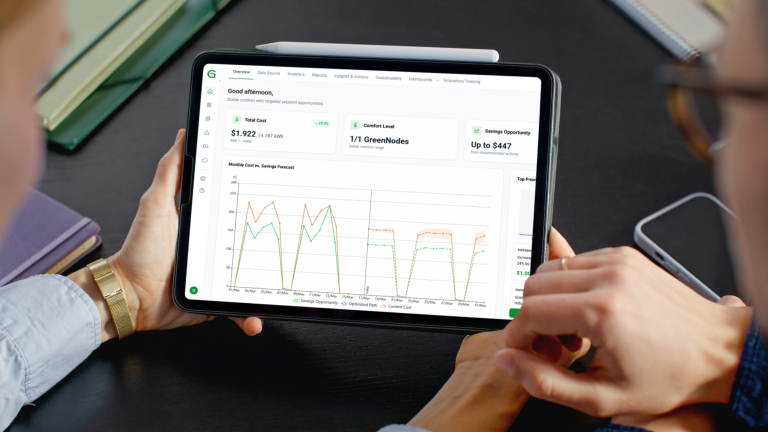
This is exactly where Greenole operates.
Not as another monitoring layer on your dashboard, but as the intelligence layer that transforms fragmented data into precise operational decisions.
By connecting multiple data sources and interpreting what truly matters for your business, Greenole enables facilities teams to move beyond constant firefighting and into a more strategic, predictive mode of operation.
Buildings are becoming increasingly complex, but complexity shouldn’t mean difficulty.
The future of building operations lies in systems that connect, make sense of data, and support the people on the front lines.
Because in the end, the value isn’t in the data itself, it’s in knowing what to do with it.