A building can have thousands of IoT (Internet of Things) sensors, connected systems, and years of stored data. Yet its operations can still start from scratch every day.
According to estimates across the maintenance and facilities management industry, teams can spend a significant portion of their operational time diagnosing problems that have already happened before, rather than addressing their root causes. This happens when data records what happened, but operations cannot learn from the past.
A failure occurs. The team receives an alert. The problem is investigated and resolved. The work order is closed. Days or weeks later, the same behavior appears again and the entire process starts over.
This cycle is common in complex building operations. The problem is not necessarily a lack of data. It is a lack of operational memory: the ability to preserve context, recognize patterns, connect events over time, and use what has already happened to make better decisions.
What Is Building Operational Memory?
Building operational memory is a system’s ability to retain, correlate, and analyze a building’s historical data (including equipment failures, consumption patterns, and maintenance activities) to prevent recurring problems, turning raw data into continuous intelligence and institutional knowledge.
In other words, a smart building should not only know what is happening now. It should remember what happened before.
Why Isolated Data Is Not Operational Memory
Having vast volumes of IoT data does not necessarily mean having memory. A system can store millions of data points and still require someone to manually search for patterns, compare different time periods, and reconstruct what happened.
Data answers questions such as: What happened?
Intelligence and operational memory take this further: Has this happened before? Why did it happen? What did we do last time? Was the problem actually resolved?
Consider a central HVAC system that experiences an anomaly every Monday morning. A conventional monitoring system may generate an alert every time the condition occurs. But if no one connects these events over time, the operation will continue treating five similar events as five separate problems.
|
Data (Reactive Management) |
Operational Memory (Proactive Management) |
|
Shows what happened at a specific point in time (e.g., an HVAC failure alarm). |
Determines whether it has happened before and identifies the likely root cause. |
|
Requires time-consuming manual analysis across multiple spreadsheets. |
Automatically correlates historical variables such as weather, occupancy, and failures. |
|
Focuses on immediate correction—putting out fires and closing work orders. |
Focuses on predictive maintenance to prevent recurrence. |
|
Disappears or remains in an individual team member’s memory when the shift ends. |
Creates a permanent, accessible institutional knowledge base. |
This memory significantly reduces dependence on individual knowledge. When a facilities operation relies exclusively on someone who “knows how the building works,” that knowledge can disappear when the person changes roles or leaves the company.
A truly intelligent operation turns individual experience into shared knowledge.
What Does Facilities Management Need to Remember?
Operational memory means turning a building’s history into useful knowledge for the team. This involves much more than storing alarms or recording work orders in software. A high-performance operation needs to remember:
- Recurring failures: What has failed before, how often it happened, and whether previous corrective actions were effective.
- Abnormal behavior: What has changed compared with the expected performance of systems and assets.
- Consumption and waste: When and why certain energy consumption patterns repeat, something critical for energy efficiency and meeting ESG goals.
- Predictive maintenance: Which actions have already been performed and whether they actually prevented equipment failures.
- Operational decisions: What was done previously in critical situations and what the outcomes were.
The Impact on Compliance
Operational memory also needs to account for building compliance. Inspections, mandatory maintenance, certifications, deadlines, and records are all part of building operations.
When this information is scattered across documents, emails, or disconnected notes, the risk of missing deadlines increases and so does the difficulty of providing the necessary history during an audit.
Building Operating System (BOS): From a Building That Reacts to One That Learns
This is where the concept of a Building Operating System (BOS) becomes essential.
A BOS creates an intelligence layer across a building’s different systems and data sources. Often working alongside enterprise technologies, a BOS does not simply present isolated information; it connects operational data, context, and history.
The result is a clear evolution in the way buildings are operated:
Monitor → Understand → Remember → Learn → Act.
The value of a modern system is not simply detecting that a problem occurred. It is recognizing that it has happened before, considering the history of previous actions, and identifying the best next step.
Maintenance, inspections, and requirements stop being simply a list of tasks to check off and become part of the building’s operational intelligence.
How Greenole Creates Operational Memory in Practice
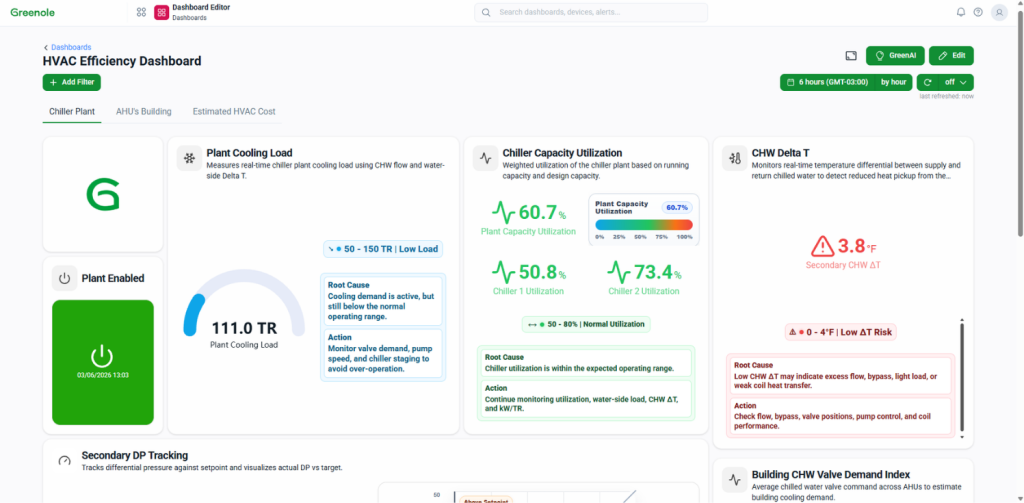
Greenole brings this evolution to life by connecting a building’s different systems and data sources through a Building Operating System (BOS), creating a robust intelligence layer across building operations.
Instead of treating every alert, work order, or event as an isolated occurrence, the platform connects what is happening now with the building’s complete operational history.
This helps facilities and maintenance teams identify:
- Recurring failures;
- Energy consumption patterns;
- Abnormal asset behavior;
- Specific maintenance and compliance needs.
More than simply pointing out what went wrong, Greenole helps teams understand what has already been done and which actions actually worked.
The result is an operation that does not simply monitor the building passively, but actively learns from it. The platform transforms historical data into context, context into intelligence, and intelligence into better decisions.
The Future of Building Operations Requires Memory
The next evolution of building operations will not be defined simply by how many sensors are installed or how many systems are connected to the network. It will be defined by the ability to transform the data generated by those systems into knowledge that persists.
An operation that does not remember previous failures will continue fixing the same problems. An operation that does not remember consumption patterns will continue wasting energy. And an operation that is blind to its compliance requirements will increase corporate risk.
Data shows what happened. Operational intelligence helps explain why. Operational memory ensures the building does not have to learn the same lesson twice.
It is this continuous cycle of observing, understanding, remembering, and acting that transforms bricks, cables, and connected systems into a truly intelligent building operation.